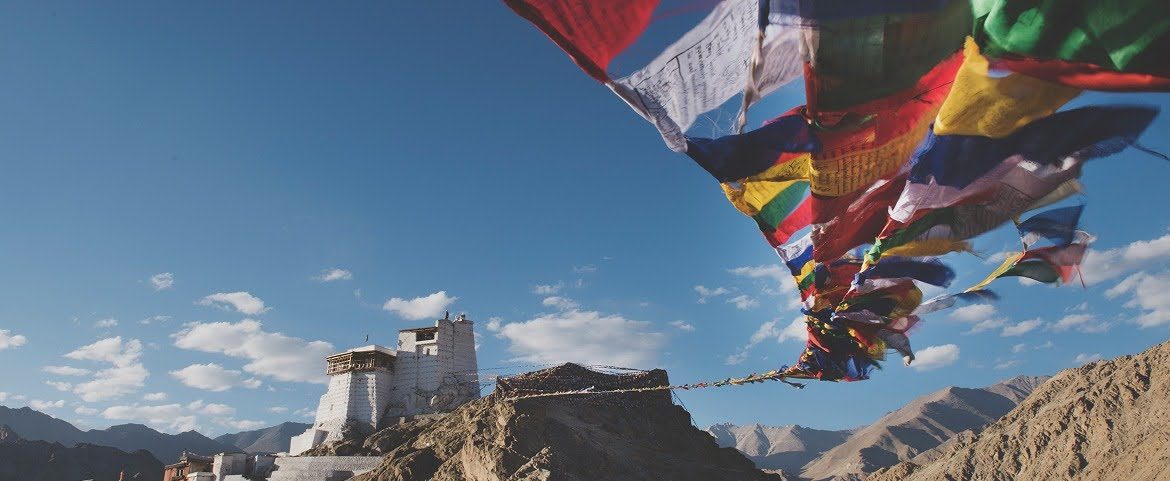
A burst of colourful ribbons looms in the distance, stretching between rocks, rooftops, or mountain ridges.
These cloth flags are among the most recognisable symbols of the Tibetan Plateau.
They are sacred cloth banners printed with prayers, mantras, and auspicious symbols. These carry hopes and prayers intended to spread blessings, compassion, peace, and good fortune to all living beings. As the wind moves through the flags, it is believed to carry these positive intentions across the surrounding landscape.
For many first-time visitors, they become one of the defining visual memories of Tibet.
Beneath their striking appearance lies a spiritual tradition that speaks a language deeper than decoration.
The story of Tibetan prayer flags begins long before Buddhism arrived in Tibet.
Many scholars trace their origins to the ancient Bon tradition, an indigenous spiritual system that flourished throughout the Himalayan region before the spread of Buddhism. Early practitioners believed that natural forces, especially wind, carried sacred energy through the landscape.
Colourful banners and symbolic cloths were often used in rituals intended to harmonise human life with these elemental forces.
When Buddhism entered Tibet during the seventh century, these older traditions did not disappear. Instead, they gradually merged with Buddhist teachings brought from India and adapted to the unique cultural landscape of the Himalayas.
Over centuries, monks began printing sacred mantras, prayers, and protective symbols onto cloth banners. The resulting tradition evolved into the prayer flags seen throughout Tibet today.
This blending of influences is one reason the question of what the Tibetan prayer flags are cannot be answered solely through a religious lens.
They represent a uniquely Tibetan synthesis of landscape, spirituality, history, and cultural identity.
This blending of ancient beliefs and Buddhist philosophy is one reason Tibet feels so distinct from other Himalayan destinations. Travellers interested in exploring how spirituality, trade, and cultural exchange shaped wider regions of Asia often discover similar themes through luxury Silk Road tours with Intriq Journey, where ancient caravan routes connected diverse civilisations across deserts, mountains, and high plateaus.
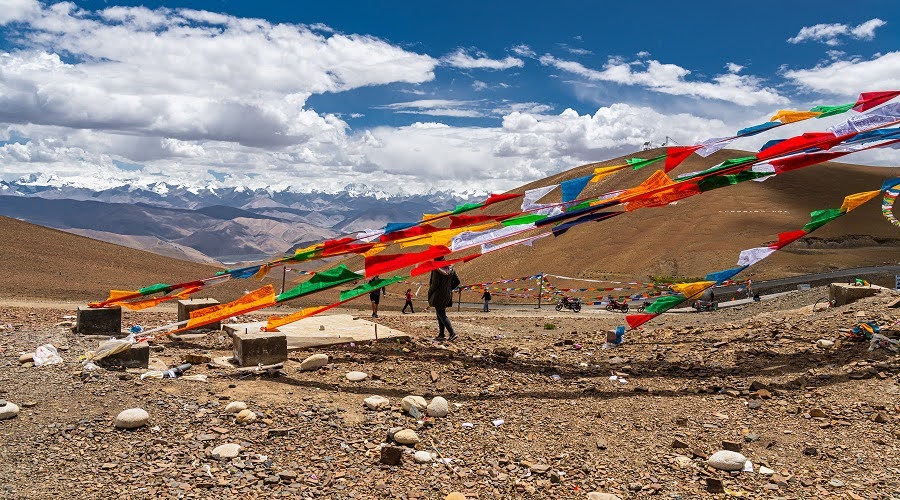
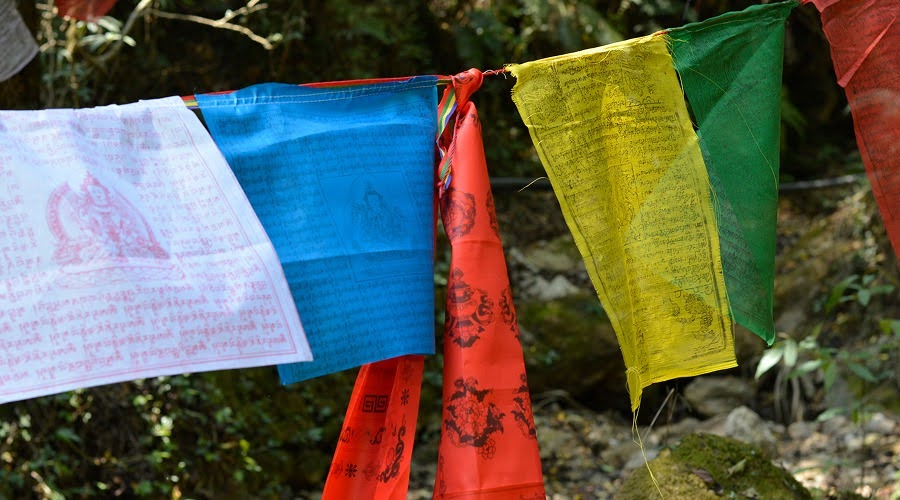
For travellers encountering prayer flags for the first time, it is often the colours that leave the strongest impression. Blue, white, red, green, and yellow ripple across the landscape, standing out vividly against snow peaks, golden grasslands, and weathered stone monasteries.
Yet there is a deeper meaning behind Tibetan prayer flags, which lies in what those colours represent.
Prayer flags traditionally appear in a fixed sequence of five colours:
Together, these colours embody the five elements that form the foundation of Tibetan cosmology.
The sequence is not arbitrary. Each element is believed to exist in relationship with the others, creating balance within both the natural world and human life.
Seen in this light, prayer flags become more than religious symbols. They are visual reminders of interconnectedness, expressing a worldview in which human wellbeing depends upon harmony with the wider environment.
This elemental philosophy is particularly meaningful in Tibet, where daily life has long been shaped by powerful landscapes, high altitudes, and an intimate relationship with nature.
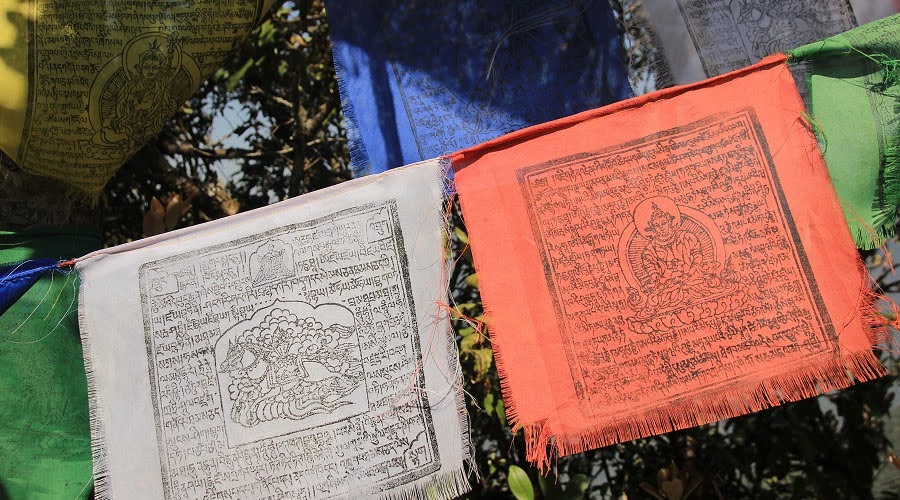
Among the many sacred images found on prayer flags, one appears more frequently than any other.
At the centre of countless banners stands a mythical horse carrying a flaming jewel upon its back.
This figure is known as the Wind Horse, or Lungta.
For this reason, many prayer flags are specifically called Lungta prayer flags.
The concept of Lungta occupies an important place within Tibetan culture. While exact interpretations vary, the Wind Horse is often associated with vitality, fortune, confidence, spiritual strength, and positive energy.
The horse itself symbolises movement and momentum. The jewel it carries represents wisdom and enlightenment.
Together, they create one of the most enduring examples of Lungta wind horse symbolism, expressing the idea that spiritual wellbeing can elevate both individual lives and the wider community.
Surrounding the Wind Horse are often prayers, mantras, and images of protective deities.
As the flags move in the wind, these blessings are believed to spread across the surrounding landscape, benefiting all who pass through it.
This collective orientation is one of the qualities that distinguishes Tibetan prayer flags from many other forms of devotional practice. Their purpose is not primarily personal. They exist for the wellbeing of everyone.
One aspect of prayer flags often surprises visitors.
Unlike sacred objects that are carefully preserved, prayer flags are expected to weather and fade.
Months of sun, wind, snow, and rain gradually soften the colours until the cloth eventually frays and disintegrates.
This process is not viewed as damage.
Instead, it forms part of the symbolism.
As the printed prayers fade into the environment, it is believed that their blessings have already been released into the world. The gradual disappearance of the flags also reflects Buddhist teachings about impermanence, reminding observers that all things eventually change and pass away.
New flags are often raised alongside older ones, creating a visible cycle of renewal that mirrors broader Tibetan spiritual beliefs.
For many travellers, this quiet acceptance of impermanence becomes one of the most memorable aspects of encountering prayer flags across Tibet.
Prayer flags appear throughout the Tibetan Plateau, often marking places where geography and spirituality intersect.
Travellers commonly encounter them in several locations.
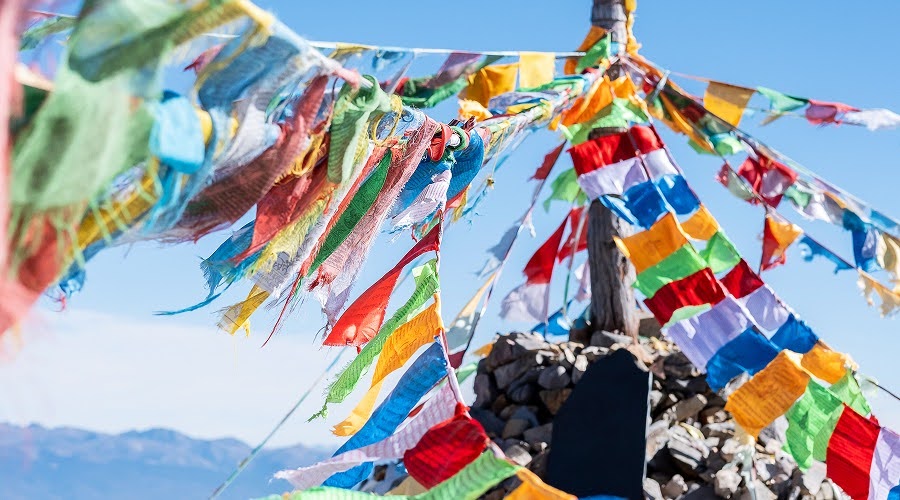
High passes are among the most dramatic places to encounter prayer flags.
As travellers reach the summit of a pass, they often find thousands of flags stretching across the ridgeline, creating waves of colour against vast Himalayan horizons.
These locations are traditionally associated with prayers for protection, safe journeys, and gratitude for a successful crossing.
Many monasteries display prayer flags on rooftops, courtyards, and surrounding hillsides.
Places such as the renowned Jokhang Temple and the great monastic institutions surrounding Lhasa often feature prayer flags integrated into the sacred landscape, connecting architecture with the sky above.
Along traditional pilgrimage paths, prayer flags serve as reminders of devotion and spiritual aspiration.
Travellers walking sections of the famous Barkhor circuit often encounter flags accompanying prayer wheels, shrines, and sacred monuments.
Some of the most spectacular displays occur far from settlements, where prayer flags stretch across isolated ridges beneath towering mountains.
In these settings, their symbolism feels especially powerful. Wind, landscape, and prayer become part of a single experience.
Encountering prayer flags in their natural setting is often very different from seeing them in photographs. The scale of the landscape, the altitude, the silence, and the constant movement of the wind all contribute to the experience. For many travellers planning a journey to Tibet, working with an experienced tour agency in Singapore helps provide the cultural context needed to appreciate these encounters beyond their visual appeal.
These banners may be beautiful to photograph, but they remain sacred objects within Tibetan culture. Travellers should approach them respectfully.
Photography is generally possible in open outdoor settings, but it should be done with sensitivity. Avoid treating prayer flags as casual props, pulling them aside for a clearer shot, or posing in ways that may feel disrespectful. If local worshippers are praying nearby, give them space and avoid interrupting their rituals.
Travellers should also avoid stepping over prayer flags, touching them unnecessarily, rearranging them, removing old and faded flags, or taking them home as souvenirs.
Approaching prayer flags with this awareness allows travellers to appreciate them not only as striking symbols of Tibet, but as living expressions of faith, generosity, and respect for the natural world.
Many visitors initially photograph prayer flags because they are visually striking.
Yet after learning their meaning, something often changes.
The flags cease to be simply colourful features of the landscape. Instead, they become expressions of an entire worldview, one that sees spirituality not as something separate from daily life but as something carried continuously through mountains, valleys, weather, and movement.
For travellers seeking a deeper cultural understanding, this shift in perspective is often one of the most rewarding aspects of exploring Tibet. In many ways, the answer to what the Tibetan prayer flags are extends beyond their physical form; they represent a philosophy that connects people, nature, and spirituality across the Tibetan Plateau.
It is the difference between seeing a symbol and understanding what it represents.
Prayer flags are among the most photographed symbols in Tibet, but their true significance only becomes clear when experienced within the landscapes, monasteries, and traditions that gave rise to them. Understanding what the Tibetan prayer flags are transforms a beautiful scene into a deeper appreciation of Tibetan culture, spirituality, and the enduring relationship between people and place.
This philosophy sits at the heart of every Intriq Journey itinerary. We believe that Tibet is best experienced not as a checklist of landmarks, but as a living cultural landscape shaped by centuries of spiritual tradition.
Throughout the journey, seemingly simple sights reveal deeper layers of meaning. A line of prayer flags draped across a mountain pass becomes more than a striking photograph when you understand the beliefs behind it. A monastery visit becomes richer when its rituals, symbols, and history are placed within the broader story of Tibetan Buddhism. Even a walk through Lhasa’s ancient pilgrimage routes takes on new significance when viewed through the perspective of those who have followed them for generations.
Through expert local insight, carefully curated cultural encounters, and thoughtfully designed itineraries, Intriq Journey helps travellers move beyond observation towards genuine understanding. The result is a more meaningful connection to Tibet’s landscapes, traditions, and spiritual heritage.
If you are ready to experience Tibet beyond the guidebooks and gain a deeper appreciation of the stories woven into its mountains, monasteries, and sacred sites, contact us to begin planning your bespoke Tibetan adventure.