
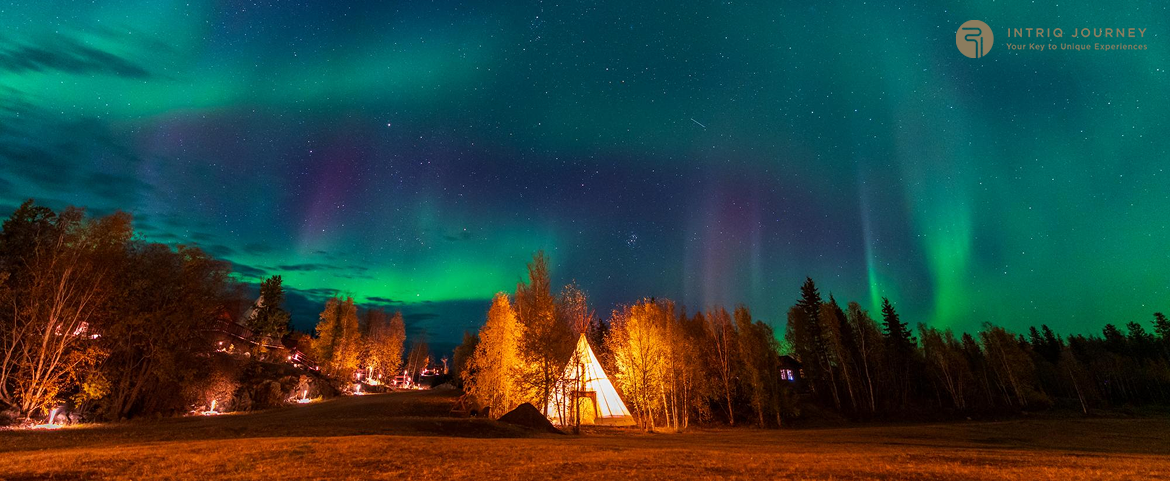
The Northern Lights, also known as the Aurora Borealis, occur when charged particles from the sun collide with Earth’s magnetic field, creating sweeping ribbons of green, purple, and pink light across polar skies. Scientifically fascinating yet emotionally powerful, each display is unique. The lights shift, intensify, and fade without warning, making every sighting feel rare and deeply personal.
For many travellers, the first faint shimmer feels almost unreal, a subtle wash of light that gradually gathers confidence before unfurling across the sky.
There is often a hush that falls over the landscape when the aurora appears, as if the Arctic itself pauses in quiet acknowledgement.
As you stand beneath it, time seems suspended, the vastness of the sky placing everyday concerns into gentle perspective.
Yet asking where you can see auroras is only the beginning. The journey becomes as much about anticipation as arrival, about waiting beneath cold, star-laced skies with a sense of expectancy.
Each evening carries a quiet tension, a shared glance toward the horizon, a collective hope that tonight will be the night.
Experiencing them well requires thoughtful planning. Location, season, weather conditions, and time spent in auroral zones all influence your chances of success. A well-designed journey combines remote dark-sky settings with comfortable accommodation, expert guidance, and flexibility to adapt to real-time forecasts.
In the Arctic, patience becomes part of the ritual, and the waiting itself deepens the eventual reward.
The contrast between the warmth of a lodge and the crystalline air outside heightens every sensation, making the first sweep of colour feel even more vivid.
Whether viewed from a glass-roofed suite in Lapland or beneath Arctic fjords in Norway, witnessing the Northern Lights is more than a photo opportunity.
When the sky finally ignites in motion, the experience feels less like observation and more like participation in something ancient and elemental.
The memory lingers long after the lights fade, carried home like a quiet secret shared between traveller and sky.
It is a moment of stillness and awe that rewards preparation, patience, and the willingness to travel far beyond the ordinary.
When deciding where you can see auroras and how best to experience them, travellers often face a key choice: join a guided tour or plan a fully independent journey. Both approaches offer advantages, but the right option depends on your priorities, flexibility, and comfort level in Arctic environments.
In remote Arctic regions, where distances are vast and conditions can change quickly, that decision often shapes not just convenience, but the overall emotional rhythm of the journey.
The choice influences whether your experience feels carefully orchestrated or entirely self-directed beneath the northern sky.
Guided aurora tours provide structure and expertise. There is a quiet reassurance in knowing that experienced professionals are tracking the skies while you focus on the moment itself.
Instead of scanning forecasts alone, you can settle into the anticipation, confident that every opportunity is being thoughtfully pursued.
Professional guides monitor real-time solar data and weather systems, increasing your chances of successful aurora viewing. Transport to remote dark-sky locations is arranged for you, and many operators include photography assistance, thermal gear, and contingency plans if cloud cover shifts. Luxury tours often add premium accommodation, private transfers, and curated experiences such as snowmobile safaris or fjord cruises. For travellers seeking convenience, local insight, and strategic positioning, guided programmes reduce uncertainty.
These structured services help travellers move beyond simply asking where they can see auroras and instead focus on maximising actual viewing opportunities.
DIY travel, on the other hand, offers independence and spontaneity. You can set your own pace, explore lesser-known regions, and adjust plans freely. However, it requires deeper research into aurora forecasts, road conditions, and regional weather patterns. In remote Arctic areas, driving long distances at night in icy conditions may not suit every traveller.
Ultimately, if your primary goal is maximising your chances after asking where you can see auroras, guided expertise can provide a measurable advantage.
In a landscape defined by unpredictability, guided expertise can transform hope into a carefully managed pursuit.
When travellers ask, “Where can you see auroras at their most vivid?”, the answer consistently points toward destinations clustered around the Arctic Circle. These regions combine geomagnetic positioning with dramatic natural landscapes.
There is something inherently theatrical about Norway’s Arctic north, where the landscape feels as though it was designed as a stage for the sky.
If you are researching where you can see auroras with cinematic backdrops, Norway often tops the list.
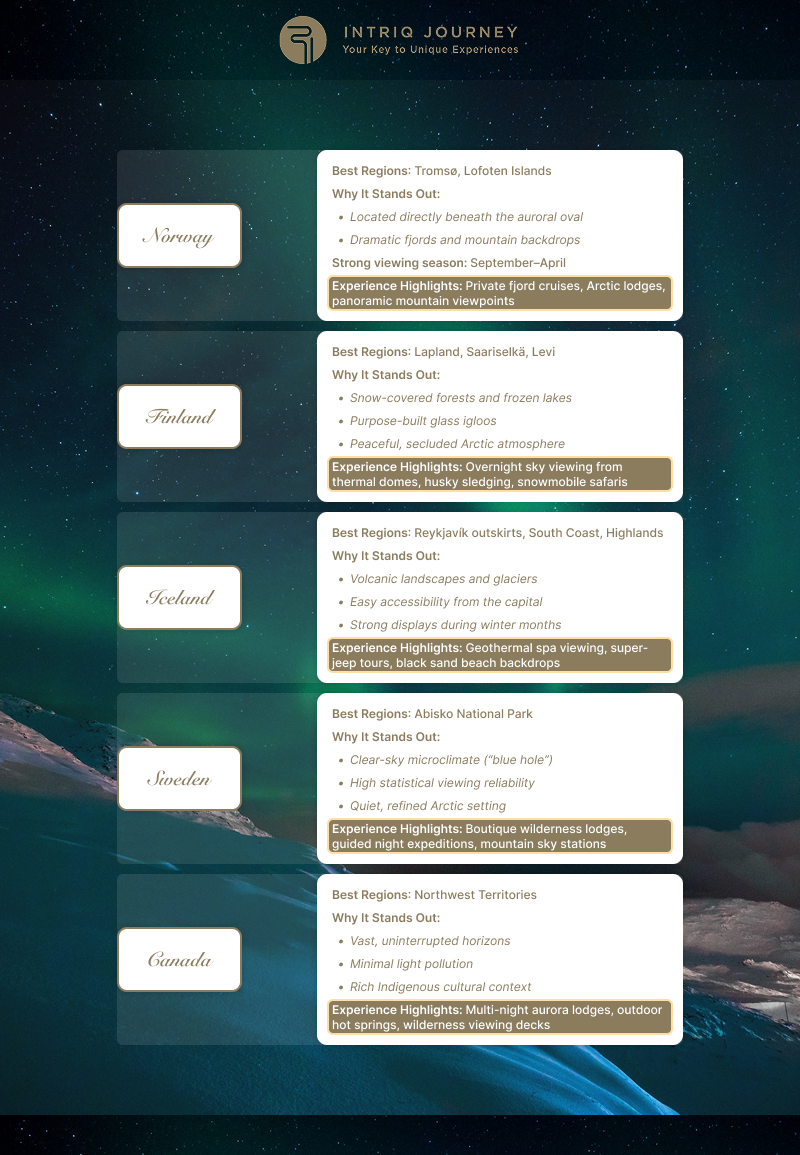
Tromsø sits directly beneath the auroral oval, making it one of the most reliable Northern Lights destinations in Europe. The auroral oval is a ring-shaped zone around the Earth’s magnetic poles where aurora activity is most concentrated due to interactions between solar particles and the planet’s magnetic field. Locations positioned within this band experience higher frequencies of visible displays.
Surrounded by snow-covered peaks and fjords, it offers strong viewing potential from September to April.
On still winter nights, the fjords fall silent, their dark surfaces waiting to mirror whatever spectacle unfolds above.
Further south, the Lofoten Islands combine jagged mountains, traditional fishing villages, and mirrored Arctic waters that reflect the night sky in near-perfect symmetry. Here, luxury rorbuer cabins and boutique Arctic hotels provide warmth and privacy between sightings, allowing guests to retreat into refined comfort while awaiting the next celestial display.
Premium experiences unfold with equal elegance. Private fjord cruises glide through darkened waters, positioning guests away from light pollution as the aurora shimmers overhead. Glass-roofed suites with heated floors invite uninterrupted skyward views from the comfort of a beautifully appointed interior. For those seeking elevated perspectives, helicopter transfers to remote mountain vantage points offer sweeping panoramas where the lights can be witnessed in expansive solitude.
Norway answers the question “Where can you see auroras?” with consistency and visual drama.
There is a gentler quality to Lapland’s Arctic, one that feels less dramatic and more contemplative, as though the landscape itself invites stillness.
For travellers seeking a more intimate Arctic atmosphere, Finland’s Lapland region is often recommended when discussing where you can see auroras in comfort.
Lapland unfolds as a pristine Arctic landscape defined by snow-covered forests that stretch endlessly beneath pale winter skies and frozen lakes that mirror the hush of the surrounding wilderness. The atmosphere is serene, almost cinematic, with frost-laced trees and powdery terrain creating an immersive Nordic tableau.
What elevates the experience further are the region’s purpose-built glass igloos, thoughtfully designed for overnight aurora viewing. These architectural sanctuaries blend seamlessly into the landscape while offering uninterrupted views of the night sky from beneath thermal glass domes. Guests can recline in warmth and comfort as the Northern Lights shimmer overhead, transforming Lapland into one of the most refined settings in which to witness the aurora in both solitude and style.
These architectural domes allow guests to watch the sky from beneath thermal glass panels without stepping into sub-zero temperatures.
Destinations such as Saariselkä and Levi combine wilderness seclusion with refined hospitality. Guided snowmobile safaris and husky sledging excursions add adventure between nightly sky checks.
Finland has perfected the art of aurora viewing accommodation, making it a standout response to “Where can you see auroras without sacrificing warmth?”
In Iceland, the elements feel amplified, fire and ice meeting beneath a sky that seems perpetually in motion.
Where else can you see auroras with dramatic geological contrast? Iceland delivers.
Unlike other Arctic regions, Iceland blends glaciers, lava fields, waterfalls, and black-sand beaches. Luxury stays range from remote countryside lodges to spa resorts with geothermal pools.
The terrain carries a raw, elemental energy, making each aurora appearance feel almost mythic against the dark volcanic horizon.
Reykjavík offers accessibility, but serious viewing requires short drives beyond city lights. Private super-jeep tours allow flexibility to chase clear skies across the island.
Iceland’s appeal lies in its versatility. During the day, explore waterfalls and ice caves. At night, scan the sky.
For many, Iceland becomes the most versatile answer to where you can see auroras alongside otherworldly terrain.
There is a purity to the air here, a clarity that sharpens both the horizon and the anticipation.
Sweden’s Abisko National Park is frequently cited when discussing where you can see auroras under statistically favourable conditions.
The region benefits from a unique microclimate known as the “blue hole,” which often produces clearer skies than the surrounding areas. Fewer clouds mean higher viewing success.
On clear nights, the sky stretches with remarkable depth, revealing stars in crystalline detail even before the first auroral arc appears.
Luxury boutique lodges and private guided expeditions create an exclusive environment away from crowds. For travellers prioritising reliability, Sweden provides one of the most scientifically promising answers to where you can see auroras in Scandinavia.
In Sweden, the experience feels deliberate and composed, a setting where science and stillness quietly enhance the spectacle above.
In Canada’s north, scale defines everything, from the endless tree lines to the immense sweep of the night sky.
If you extend your search for where you can see auroras beyond Europe, then Canada offers expansive, unspoiled wilderness.
The Yukon and Northwest Territories sit directly beneath prime auroral zones. Remote lodges surrounded by frozen forests provide panoramic night skies free from light pollution.
The remoteness creates a profound sense of isolation, as though you have stepped beyond the edges of the modern world.
Canada distinguishes itself through its vast, uninterrupted horizons, where the sky feels impossibly expansive and the aurora has room to unfurl in sweeping, unbroken arcs. In regions such as the Yukon and the Northwest Territories, the scale of the wilderness creates a rare sense of solitude, allowing travellers to stand beneath a sky that seems to stretch beyond imagination.
The experience is further enriched by Indigenous cultural encounters, where local stories and ancestral perspectives on the Northern Lights add depth and meaning to the spectacle above. Listening to these narratives beneath an active sky connects the present moment to generations who have watched the same shifting lights across the centuries.
Many luxury wilderness lodges also offer thoughtfully designed multi-night aurora viewing programmes, recognising that patience is part of the ritual. Evenings are structured around comfort and anticipation, with warm interiors, panoramic viewing decks, and flexible wake-up alerts that honour the unpredictable rhythm of the sky. In Canada, the journey becomes not just about seeing the aurora, but about immersing yourself in the vastness that makes its appearance feel all the more profound.
For travellers seeking space and solitude, Canada offers a powerful response to where you can see auroras in North America.
Knowing where you see auroras is only the first step. Timing and preparation dramatically improve success rates.
The optimal season runs from late September to early April, when nights are longest.
Peak winter months bring extended hours of darkness, creating a longer window each evening for aurora activity to unfold. During this period, the probability of visible displays increases, particularly when solar conditions align with clear Arctic skies. Snow-covered landscapes add another layer of enchantment, reflecting and amplifying the auroral glow so that the entire horizon seems illuminated in soft, shifting colour. The result is not only stronger viewing potential, but a visually immersive setting that heightens the drama of the Northern Lights against a pristine winter canvas.
If you are still wondering where you see auroras most effectively, remember that season matters as much as geography.
Auroras depend on solar storms and geomagnetic activity. Use real-time aurora forecast tools that measure KP index levels.
Cloud cover is equally critical. A destination may sit beneath strong solar activity, but heavy clouds will block visibility.
Flexible itineraries, especially those designed by a professional travel agency in Singapore, allow adjustments based on weather patterns across multiple regions.
Flexibility transforms the question from simply “where you can see auroras” to where you can see them tonight”.
Aurora sightings are never guaranteed. Even in prime destinations, patience is required.
Booking three to five nights in a high-probability region significantly increases your success rate.
Luxury lodges often design their itineraries around this principle, ensuring that every possible opportunity to witness the aurora is thoughtfully maximised. Guests may receive discreet nightly wake-up calls should the Northern Lights appear, allowing them to step into the moment without missing a display. Heated observation lounges provide a refined sanctuary from which to watch the sky in comfort, while on-site photography guidance ensures that even fleeting bursts of colour can be captured with clarity and precision.
If you truly want to resolve the question of where you can see auroras, time investment is essential.
Aurora viewing does not have to mean standing in freezing conditions for hours. Premium experiences elevate comfort and exclusivity.
Architect-designed igloos and panoramic cabins allow uninterrupted sky views from bed. These accommodations are engineered for insulation and thermal efficiency.
They redefine where you see auroras without exposure to harsh weather.
In Norway and Iceland, small expedition vessels navigate dark fjords away from artificial light.
Luxury small-capacity sailings align perfectly with curated luxurious tours, including options for small groups, combining exclusivity with personalised guidance.
Watching the Aurora Borealis reflect off still Arctic waters offers one of the most cinematic interpretations of where to see auroras.
Aurora travel need not be confined to quiet observation. In the Arctic, adventure and refinement coexist effortlessly. Imagine gliding across hushed, snow-laden forests by dog sled, the rhythmic sound of paws against powder breaking the stillness as twilight deepens into indigo. Snowmobile safaris carry you across frozen tundra and expansive white plains, where the horizon stretches unbroken and anticipation builds with every kilometre.
For those seeking an even more elevated perspective, helicopter transfers ascend above fjords and mountain ridgelines, revealing vast Arctic panoramas where the sky feels boundless and untouched.
These experiences layer movement and exhilaration into the journey, ensuring that the pursuit of the Northern Lights becomes not just a nightly spectacle, but a fully immersive Arctic narrative shaped by both adventure and indulgent comfort.
High-end Arctic operators design itineraries that balance adrenaline with refined hospitality.
For travellers exploring bespoke luxury tours, integrating activity with night sky monitoring enhances both excitement and efficiency.
No. Even in prime destinations, displays depend on solar activity and clear skies. Some nights may show only faint movement, while others produce dramatic arcs. However, this unpredictability is why travellers continue looking for where they can see auroras with the highest probability.
It is possible, but urban light pollution significantly reduces visibility. In cities, weaker auroral activity may be washed out entirely. Travelling to dark, remote locations significantly improves your chances of seeing the lights clearly.
No equipment is required to see the Northern Lights with the naked eye. However, photographing them effectively usually requires a camera capable of long exposures, a tripod, and manual settings. Professional gear enhances image quality, but it is not necessary for experiencing the display.
Not strictly. However, in remote Arctic environments where temperatures can drop significantly below freezing, premium lodges provide warmth, flexibility, and wake-up alerts that allow guests to rest comfortably while remaining ready for activity.
Temperatures in prime aurora regions can range from 0°C to -30°C, depending on the country and month. Arctic destinations such as northern Norway, Finland, and Canada tend to experience the coldest conditions between December and February. Proper thermal layering, insulated boots, gloves, and windproof outerwear are essential for comfortable aurora viewing, especially during extended periods outdoors at night.
Aurora activity can occur at any time after dark, but the most active window is typically between 9 pm and 2 am. This period often coincides with stronger geomagnetic activity and darker skies. However, displays are unpredictable, and they may appear earlier or later. Staying alert, monitoring forecasts, and allowing multiple nights in an aurora zone significantly improve your chances of witnessing the phenomenon.
The enduring question of where you can see auroras ultimately leads travellers toward the Arctic Circle, but the real answer lies in preparation, timing, and thoughtful planning.
The Northern Lights are unpredictable yet deeply rewarding. By selecting proven destinations such as Norway, Finland, Iceland, Sweden, or Canada, and by staying multiple nights within optimal viewing seasons, you dramatically increase your chances.
Luxury accommodation enhances not only comfort but also strategic flexibility. Private guides, adaptive itineraries, and remote dark-sky access elevate aurora viewing from hopeful to intentional.
For travellers based in Asia, Intriq Journey is a tour agency in Singapore that helps simplify complex Arctic logistics and ensures access to trusted ground operators.
The lights may never be guaranteed. Yet with the right destination, expert guidance, and patient anticipation, the question shifts.
It is no longer simply where you can see auroras.
It becomes: when will you stand beneath them?
Contact us today to begin planning your personalised Northern Lights adventure.